Thursday, 18 June 2015

Rhine River Case Study

You can work with a partner. Please make sure that you tell me who you worked with if you choose to work with a partner. 
Look at the information about the Rhine River valley. You can also look up further information if you choose. 

Questions to answer: 
1) Describe the factors that make the Rhine River the "Industrial Heartland". What area would be the industrial heartland of North America? (4 marks)
So what makes Rhine River the industrial heartland? It is a river which links different European countries together. It helps transport goods, people and ideas to these different countries.countries. It enables industrialization to take place in a more effectively because of the location the river runs through.The region around the north-eastern united states, the great lakes and Midwest stares is the industrial heart land of america. It is surrounded by water which causes it to be a suitable area for trad and the growth in the economies.  There a stronger link built near the lakes because it is in between Canada and USA. Because of the large body of water industrialization is able to occur. The water allows people to transport themselves, goods and their ideas.


2) Analyze the impact that human activity has had on the Rhine River basin. (4 marks)
Humans have a huge impact on the Rhine River basin. Much of the riverside of Rhine's marsh and floodplain was used to hold back flood water got replaced with farmland and various other buildings.Urbanization in the Rhine area has been a negative aspect as it helps the flooding to occur. Mainly because the concrete and tarmac sends more water to the river. People use the upper Rhine for generating hydroelectric power which can cause an erosion. The rivers have been involved in a straightening process due to improved navigation for shopping. This means the distance has been reduced by at least fifty kilometres whereas before it was about one thousand kilometres. Thus the reason the water moves downstream much more quickly now.

3) Suggest solutions to the environmental problems of the Rhine Riber basin and explain why these solutions may be difficult to implement. (4 marks)
Some solutions that can help the environment problems could be to promote water efficiency strategies. This can help decrease the amount of water being wasted. People can protect the water from pollution by fining solutions that can show the public is helpful. For instance green infrastructure can be a solution! Helping cities prepare for water changes can help save the Rhine river. Ensuring waterways have enough water o support aquatic ecosystems can also be another solution. Although these ideas seem great they could be difficult to implant because the Rhine river is very large at size. It goes through multiple cities such as France, Austria and Germany. It is difficult to implant in each area of those countries as everyone's point of views are different.

Case Study: Desertification in Botswana

Read the article about Botswana and answer the questions below.
1) What is desertification? Give a general overview (In your own words) of what it is and what are its causes. (4 marks)
Desertification is a process where land, that once was luxurious and living, becomes a desert. This usually occurs from a drought or deforestation. Deforestation is the action of clearing trees from a certain area. It is basically taking a  forest and demolishing it into clear land.  When there is desertification the land loses its body of water, vegetation and wildlife. Deforestation and droughts aren't always the cause of this mess. Desertification can happen from climate change and people overgrazing the land.

2) Describe the PHYSICAL characteristics of Botswana and how these are impacting desertification. Remember that physical is things that would be there whether humans existed or not and include the climate, the flora and fauna, the landscape. (4 marks)
Climate:
The raise in temperature will raise the evapotranspiration which can lead to soil humidity. The climate change can increase the number of days the land has droughts as well. The deterioration of topsoil especially in dry lands is due to the different temperatures it is facing. The deterioration of the topsoil as well is the effect of rain fall ad soil humidity which also increases the process of desertification at a rapid rate.
Fauna:
Different animal species that depend on vegetation have to migrate to different areas in order to survive. They fly/move to different areas to find resources that help them life and reduce the risk of them disappearing.  The loss drives away from the fact that animals and plant species from dry lands are particularly well adapted to the extremely dry environment and don't need to migrate.  They act as indicators of the environmental condition and their disappearance is a sign of a habitat degradation. This has a negative effect which is causing the desertification to happen in Botswana.
Flora:
he degradation of land is usually due to drought, over exploitation and salinity. The consequences on the vegetation to maintain  and flourish can be gone due to the droughts and over exploitation! This kind of poor vegetation can cause the land degradation to occur which after on results to a desert like area.
Landscape:
Land degradation would cause soil to erode or disappear. This increases the chance of the process of desertification. This has a direct affect on the water cycle! It causes it to be scarce and in threat. With less rainfall there is a more cause of droughts to occur as well.


3) Describe the HUMAN causes of desertification in Botswana. How are humans making it worse? (4 marks)
Overgrazing, deforestation and  farming are a few examples of what causes desertification. Overgrazing is where farmers allow livestock to graze to the point where its damaging the vegetation. Deforestation is when a forest filled with big flourishing trees is turned into clear land usually for agriculture. Overgrazing and deforestation is usually the main causes that lead to desertification because it either removes or damages the vegetation that is protecting and guarding the land. Another cause is farming on the land, destruction of plants in dry lands, and as well incorrect irrigation in dry regions. Some of this stuff causes a build up of salt in soils. In Botswana another reason of desertification is cause of the population. Over the past ten years the population has increased dramatically causing more food being produced. However is isn't enough water to share with everyone and is not enough for the crops to grow which is another reason why Botswana is turning into like a desert.

4) Describe some of the problems associated with solving the problem in Botswana, as well as some of the steps that have been taken to protect the environment and people. (4 marks) 
One of the major problems in Botswana is the growing population. Because of the huge population there is not enough water going to everyone needs. The population needs to be managed otherwise things can go out of hand in a negative manner. By decreasing the population there will be a decrease in human activities which is a cause for desertification. Educating the public is the golden ticket to help reduce desertification. Educate the people on how to respect the environment and to only use the resources which are needed efficiently. Im not sayingthre has been no help in saving Botswanna. Thepublic has tried to minimize their grazing, deforest and damages however not alot of people know how to help the environment around them

Sunday, 14 June 2015

Case Study: Flooding in Brisbane Australia

Using the links provided below answer the following questions. 
1) Describe the causes of the flooding. Consider both the natural and human causes of the flood. (4 marks)
Flooding can occur   from either human causes or natural disasters. Flooding is usually in communities which are near the coast. One of the major causes in flooding in Australia is heavy rainfall. Other natural causes , which cause flooding, are hurricanes, tsunamis and violent storms. Some floods don't happen from natural disasters but instead  its done from man made activities. For instance a human cause can be mining and urbanization. Another cause that affects floods can be from pollution and infrastructure. 

2) Describe the social (impact on people), economic (money), environmental impacts of the floods. (12 marks)
Some social impacts that happen from floods is the loss of lives. Some lose their life while others become homeless ad the flood destroys their home. Floods can cause people to get infections and different types of diseases as it contaminates the drinking water. Floods can injure many people as its rough waters which can carry heavy vehicles with them. In the end even if the flood has cleared out it has affect many survivors physiologically. They may be traumatized due to losing a family matter or seeing such a vivid event take place. Floods can plummet economies. The destruction caused on a property from floods can reduce the properties value. Federal government would need to pay for rescue aids. The price on groceries would increase because there would be limited supply due to the loss in the flood. People who become homeless would need jobs to rebuild their lost home. Not only to rebuild  homes but there also would be money needed to rebuild the city. Flooding can impact the environment severely in a negative way. It can destroy forests  and kill animals that come across its path. With floods it can contaminate other waters with various chemicals. It also destroys the natural balance of the ecosystem and leaves the landscape looking a bit different.

3) How is the government of Queensland preparing for future potential floods? (4 marks)
First for most the government is putting a lot of effort into educating the pubic on flooding and how to deal. with it when it is happening. They want to make sure the public is prepared to face a flood without fear but with more strength. The government of Queensland is trying their best to prevent flooding by creating solutions which can overcome the heavy rainfall. A major cause of flood here is because of the overflow of drainage. They became very nasty when its combines with heavy rainfall. Australians are now building stronger homes by getting sturdier framing done and also are building their houses on higher ground.

*Please note: My parents live in Brisbane and were there during the floods! I know this area very well (I have been 5 times). you will NEED to read all of these articles and not just copy down the first thing that you see.

Saturday, 13 June 2015

Impact of Fishing


For this assignment you are going to reflect on the documentary "End of the line" that we watched in class. 

a) Consider the impact on the following stakeholders as described in the film. (2 marks each. /8)

-Fishermen (they talked about Canada, East Africa, The eastern USA)

The people that depend the most on the fishing industry are the fishermen. It is what gets the food on the table for them. Fishermen depend on fishing to help provide for their families. The impact on fishing is a major positive to the fishermen because its what they rely on to gain money. Without fishermen consumers like us would not be able to eat the fancy fish dishes we like. The government also rely on fishermen because they need to gain profit and money.


-Consumers (think about the people who buy fish, and the restaurants that sell it)
Consumers who eat fish on daily bases rely heavily on the fishing industry. Some people eat fish to cover health concerns in a proper manner. For instance people who lack vitamins and minerals may eat fish to gain it. People who need Omega-3 would also eat fish to gain the Omega that they need. Fishing also has a positive impact on consumers because it is a demand for fish lovers.  Especially in high class restaurants fish is used as a main meal for simplicity and flavourism.

-Governments
The government as well heavily rely on the fishing industry. The more fish fishermen catch the more profit the government gains. They can make more money from fishing companies. The fishing industry also is a big positive for the government as it gains them profit from both consumers and fishermen. As people will pay more money for  fish delicacies which causes the fish industries to boom!


-The Environment
The environmentalist however are not happy about the fishing industries. By fishing it leads to a loss in fish species because sometimes fishermen over fish. Environmentalist are concerned about the fishes because taking away a certain type of fish can screw up the food chain. Ecological disruption is not a positive yet a negative in fishing.


b) Research fishing in your country. (/10)
-Is it a major industry? (If not look at the salmon industry in British Columbia)
-Has it been impacted by overfishing and climate change? How? 
-How will species depletion impact your country?

Indonesia is one of the biggest seafood producers in the world. It is one of the countries which is the most productive with aquaculture and wild stock fishing. This country is ranked the fourth most populous country that contains  major seafood consumers. The fishery production is totaled at 15 million tonnes in 2012. Aquaculture stands at 9 million and wild stock is at 5 million tonnes. Most of their shipments are sent to the states and Japan. However with climate change and over fishing there are certain negatives and positives in the concern. The effect of sea level rise means that coastal fishing communities are in the front line of climate change. They will have a harder time fishing in poor weather.  While on land the changing rainfall patterns and water use impact on inland fisheries and aquaculture. Indonesia is big on aquaculture and gain most of their profit from aquaculture. This does not just impact the townspeople but as well the fishes and other marine animals.  For instance the rising ocean acidity makes it more difficult for marine organisms such as shrimps, oysters, or corals to form their shells. This is creating a defect in the food web as these animals have to find alternatives for survival. Species depletion would have  major impact on Indonesia! There would be alack of biodiversity in the waters and would lack balance in the food chain. There would be more of one certain fish than another and could lead to the loss of more species. Depletion for species will also cause fishing industries to decline. As the fish decline there would not be enough supply to fulfill the demand of fish for the consumers. 

Case Study: Glacial Retreat

Part A) Read the links provided and then answer the questions below. 
1-Look at the links related to the Himalayas, Glacier National park and Antarctica. FOR EACH, give SPECIFIC examples of how the glaciers in that area are behaving. (9 marks)
Himalayas:


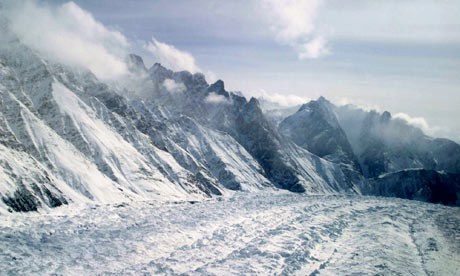
The Himalayas is a mountain range in South Asia which is a home to nine of the ten highest beaks on earth. These mountains have the highest concentration of glaciers from the polar icecaps. Glaciers in this area are growing lusciously because the climate is healthy and durable. In the warmer times when the climate is much warmer the glaciers tend to retreat. The Siahven Glacier is one of the largest glaciers in the world; however,  a survey done by the Pakistan Meteorological Department in 2007 revealed that the Saichen glacier has been retreating and melting at a alarming rate.  This big glacier is retreating at a rate of 100 meters a year.

Antarctica:


Antarctica is Earth's southern most continent which is the coldest and driest. There has been major concerns for the glaciers in this area because of the climate change. Since the records have been taken the temperature there have risen drastically. Warming till this day continues and is much worse int he summer. It causes the glaciers to melt at an alarming rate and can lead to losing some of its icy glaciers. The change in temperature is resulting in the collapse of several ice shelves. Glaciers are thinning and shrinking around Antarctic Peninsula. The Antarctic Peninsula is the northernmost part of the mainland of Antarctica, located at the base of the Southern Hemisphere. The high rate of temperature in Antarctica is among the highest seen anywhere on Earth recently!


Glacier National Park:

The hot climate change is also being very popular at the glacier national park. The region now experiences on average more than eight days a year where the temperature us above 90 degrees. Because of this high temperature change the glaciers are shrinking and thinning out in size.

2-Discuss the Social, Environmental, and Economic Impact of Glacial Retreat. (9 marks) 

Social Impacts:
1.Since ice will no longer be available for winter sports there a result in a loss of tourism. Less tourists will be wanting to visit an area that has very little ice and snow to do their winter activities. Locals who live near the glaciers would be losing that extra income they made from tourism.
2.With the glacier retreat there are factors of unreliable snowfall which results in there begin less snow for winter sports.
3. People can be displaced from the rising sea levels


Environmental Impacts:

1. Theres a rise in natural disasters when a glacier retreats. For instance avalanches, rock slides and flooding.
2.Melt water is another concern. It makes flooding occur which can be evaporated back in to the air and then contribute to the rising sea water levels when it comes down as rain.
3.Rising sea water has an effect one rosin of the coastal towns!
4.Rivers flow can be altered.

Economic Impact:
1. Tourism plays another role as well in the economic part. There would be a lost in revenue because there are less tourists visiting the snowy mountains.
2.The destruction of land and property due to the natural disasters will be pricey to rebuild.
3.Will need to money to furnish everything back to normal (like rebuilding the city).

Part B) Research the impact that glacial retreat will have on the tourism industry in areas that currently have glaciers. (think about Alaskan cruises, Banff, The swiss alps, etc) *There are a few links below but you may want to look further. (10 marks)

Glaciers play an important role in tourism especially up north. It is an attraction many people  love. They may just sit and watch the view or do fun winter  activities on the glaciers. For instance people go skiing, tubing or even sledding on mountains. Hundreds and thousands of people go visit the Swiss alps, Alaska and the glacier National park. As the climate gets hotter the glaciers start thinning out and shrinking in size. Which makes it less available for the tourists to go do their winter sports. Shrinking glaciers can lead to a reduction in glacier touring and cruise ship tourism which results in a loss of money. This loss affects the economic part in the city big time. As an example the ice berg lake in  Glacier national park make about three billion dollars a year. If the glaciers continue to shrink they would lose a lot of that money. The tourism industry would be destroyed within a blink of an eye. The reduction in size of the glaciers results in less tourists which results in no profits for the locals. 
Image result for swiss alps with tourist
The Swiss Alps attract thousands of tourists.

Part C) Discuss the impact that retreating glaciers will/have already had on your country. If you have a country that does not have glaciers specifically in it think about general impacts as a result. (5 marks)

In Indonesia there are tropical glaciers; however, within a couple of years scientist say these glaciers will disappear. Scientist have seen that the glaciers on Puncak, Jaya in Indonesia have melted about 60 percent and believe the 40 percent will be gone within a few years. A local tribe believe the mountain is their god. If the glacier was to be gone they would lose a piece if their soul. They heavily rely on the mountains to live and sustain live. The glacier falls into their cultural activities and normal day living. Many universities students go on hikes and treks on this mountain to view the glacier. If the glacier was to vanish fully this part of Indonesia would lose their hikers. Many of these hikers need a night to stay and food to live. So the locals make money from tourists by providing them food and a night to stay. There would be a huge economic loss to the country if tourists decided to stop coming to the glaciers.
An aerial view of glaciers near the summit of the 4,884-metre (16,000-foot) Puncak Jaya mountain in the Indonesian part of New Guinea island
Glaciers near Puncak Jaya in Inodenisa

Thursday, 11 June 2015

Waikiki Beach Case Study

This is the last case study I will post. You have this week to work on ALL of the case studies that I have posted. 

Read the links below and answer the questions. 


1) Describe the causes of erosion on Waikiki Beach. (5 marks)
Waikiki Beach is a man made beach which is on the edge of disappearing. It has been having erosion problems since the late 1800's. It began when hotels and homes were begin developed too close to the natural shoreline. This blocks the natural flow of sand along the beach.  Because of the erosion it has caused a concrete slab near the waters edge! This concrete has sharp edges and is very uneven. The major cause is from buildings being built near the shoreline; however, as well the removal of the pier.  Because if this there is a loss of soil structure and soil acidity problems.

2) Describe past and present attempts that have been made to save the sand of Waikiki beach. Assess how well you think that they have worked. (10 marks)
Sand bags being used to save the beach!
There has been many different solutions put out to fix Waikiki beach but has only help in a very little way. With the sea level rising it is starting to claim bout a foot of the beach each year. There has been over ten projects done to save the beach since 1939; however, most of the projects were the same. They involved adding sand to the beach. One solution the states department came up with was to add 24,000 cubic yards of offshore sand across the beach. This "adding sand" project was done in June 2012 and costed about 2.2 million dollars. However one fourth of the sand was gone within a year after it was put there. I believe the sand idea was a good try. I doubt they could have not figured out it would have not worked. I think it could have worked if more research was done on the sands disappearance. The states department could have put the money into researching and then come up with a different sustainable solution which could have benefited the beach. Another minor project the city started was putting sand bags across the beach to keep the water from touching the beach and taking the sand with it.

3) Describe the economic, social, and environmental impacts of erosion of Waikiki beach for both the residents of the area, and tourists. (15 marks)
Eroding at its finest,
One of the major economic impact is the loss of tourists. If there are less tourists visiting the beach hotels revenue is affected. The hotels would not be making much because a lot of tourist are deciding against staying at a eroding beach. 58% of westbound visitors told in a survey they would not consider staying in Waikiki if the beach is no longer available. With the beach disappearing about 6000 thousand people could lose their job. The potential economic impact due to a complete erosion of the beach is estimated to be two billion dollars. Environmentally the erosion can have a major affect on the air quality. Soil particles which get suspended into the air by wind are easily inhaled by humans and animals. Breathing in these particles can lead to respiratory problems. This erosion also affects the soil nearby. Erosion gradually depletes organic matter and decreases soil productivity. This usually leads the soil to lose its ridged structure and makes the soil very hard and cloddy. This erosion can lead to flooding. If there was a major flood to take place it would impact the beach socially. The people living near the beach could lose their homes and become homeless. It can contaminate the drinking water which us humans need. By drinking the contaminated water we can get sick and risk death. Before as i was talking about the air quality, it also can affect us socially. We would be breathing in air which potentially can lead us to have respiratory problems.

Monday, 1 June 2015

Mining

Mining
Strip mining
Aka. Open
Pit mining


Shaft mining           


Part A) For each type of mining you will research what it is (how it is done) as well as the pros/cons of it of each type.

You should have a minimum of 3 examples for both pros and cons for each of the two types of mining.


Part B) Once you have an idea of the different types of mining as well as the pros/cons of that type of mining you will put yourself in the shoes of the stakeholders below. Considering the PROS /Cons of the two mining types, which would you prefer?

For each stakeholder, explain the type of mining you would prefer and WHY.
Spouse of a miner
Owner of a mining company
Environmentalist
Owner of a nearby ski resorts
Politician

Part C) Research mining in your country. Is it an industry that exists?
If yes, what do they mine for? What time of mining is common?
If no, explain some reasons why mining is not common in your country.


Part A:
Open pit mining Pros :
-Greater safety when compared to shaft mining because its not underground and workers are not endangered by harsh chemicals.
-Get more minerals than shaft mining as it results in high recovery to that type of resource.
-Cheaper costs for mining companies

Shaft mining Pros :
-It allows minerals to be extracted from deep underground
-It doesn't create a mess like  open cut mining as its underground
-Doesn't affect the physical environment on top of the lithosphere

Open pit mining Cons :
-Pollution and drainage occur and is serious to the environment especially when it touches the water
-Loss of ecosystem because this mining eliminates biological life at the surface
-possibly could impact the air quality

Shaft mining Cons :
-safety underground is limited because underground a lot of methane can be produced which can kill humans
-more possibilities of fatalities in shaft mining
-higher costs to go through with operations 
Part B :
Spouse of a miner
As a life partner my main concern would be safety. I would choose open pit mining as there are less  casualties. It allows my spouse to come home safe and i know he or she wont be in trouble or stuck in a bad event.

Owner of a mining company
If i was a owner of mining company i would choose openshaft mining. The safety of my workers is a must as they are providing their trust in me. Open shaft mining is a lot of safer than underground mining. As well the costs is cheaper so its a win win situation.

Environmentalist
As an environmentalist i would choose the underground mining. First off when the mining is done underground the physical appearance of the top is not changed and left the same. So animals still have their habitat on the surface of the land.

Owner of a nearby ski resorts
If i owned a ski resort i would obviously not want a openshaft mining happening near my resort. It would drive the public away and when its underground most cant see what is happening because the top part of the surface is clean and left untouched.

Politician
As a politician i would do open shaft mining. It is much cheaper and safer than underground. So there are less casualties to happen when workers are working on the surface and can not blame the government if someone was to die. Because it is cheaper it also also the workers get more minerals.


Part C :

In Indonesia there is a lot of illegal mining. Most mining is done underground its very rare to see open pit mining. Probably because with underground mining you can go in deeper looking for valuable products. In the end there is a less of a mess created on the surface which leaves the environment looking clean. Indonesia mainly is mined for its coal and nickel.  Other products that are extracted are copper, tin, asphalt an petroleum.